Showing posts with label Legends Never Die. Show all posts

Saturday, May 12, 2018

Marvel Star Wars: Issue 8: Eight For Aduba-3


Han's conversation with the villagers introduced at the end of the last issue is interrupted by a reptilian who's mad Han was making moves on his girl. A cantina brawl ensues.

Victorious, Han & Chewie hear the villagers' plea. Their poor farming village is beset annually by a gang of vicious rogues and bandits called the Cloud-Riders led by Serji-X Arrogantus, “The Arrogant One.”


Realizing that he's outnumbered, Han puts out a call for hired guns and ends up with a motley assortment of spacers and locals:

Hedji, a member of the nearly extinct Spiner race, who can throw razor-sharp quills with deadly accuracy.

Don-Wan Kihotay, a clearly delusional old man who claims to be a member of the Jedi Knights and obviously based on Don Quixote. Han doesn't much believe that, but the man does have a lightsaber.

Amaiza, a beautiful female gunslinger and smuggler with a history with Han.

Jaxxon, a six-foot tall, carnivorous green rabbitt with a sassy attitude. You heard right. More on him another time.

Jimm, a local farmboy with dreams of adventure who calls himself “The Starkiller Kid” (a reference to the early draft of Star Wars). He reminds Han of Luke.

FE-9Q, “Effie” a tractor droid and Jimm's cranky guardian.


Thus assembled, Han has a tense introduction to Serji-X, and prepares to ride out to the village. Meanwhile, Luke Skywalker bids farewell to Princess Leia as he heads off on a mission to scout for a new planet for the Rebel Alliance to make its home.

The plot is clearly lifted from The Seven Samurai/The Magnificent Seven, which makes sense, since Kurosawa was a heavy influence on George Lucas.

The Cloud-Riders and their bikes are the first appearances of swoop bikes (they would first be identified as such in Han Solo's Revenge) and swoop gangs, who are, simply enough, biker gangs. Their leader, Serji-X, whose name and face are a direct nod to MAD Magazine luminary and creator of Groo the Wanderer, Sergio Aragonés in his younger days.

Right down the moustache

The Cloud-Riders themselves (with the Arrogant One being replaced as their leader with some newbie named Enfys Nest) are in Solo: A Star Wars Story, so if you pegged an obscure gang of goons from a couple issues in the 1970s making it to the big screen before Mara Jade, Grand Admiral Thrawn, or Kyle Katarn, congratulations, you have successfully predicted the downward trajectory of the franchise.

I hope Roy Thomas and Howard Chaykin at least get credit for creating the gang.


There's more to say, but there's more issues in this arc, so I'll save that for then. This issue sets up the situation and characters for the arc quite efficiently, and even the tavern brawl at the start has narrative value, since the alien who started it, Warto, joins up with the Cloud-Riders.

Sunday, May 6, 2018

Marvel Star Wars: Issue 7: New Planets, New Perils!


Marvel's adaptation of Star Wars was a financial hit. Such a huge hit that Jim Shooter credited it (and Roy Thomas, who arranged the deal with Lucasfilm) with saving Marvel's financial bacon in 1977-78.  The movie was a smash, and the comics sold accordingly, so naturally it made sense for all parties involved to continue making more Star Wars to fit the demand.

There was one problem: Movies take time to write, shoot and edit. It would be a few years before The Empire Strikes Back.


Re-enter Roy Thomas and Howard Chaykin (now with Frank Springer on inks), Issue 7 is the first piece of what would be called “Expanded Universe” fiction ever released for Star Wars. Hitting stands in October of 1977, predating Splinter of the Mind's Eye by four months.

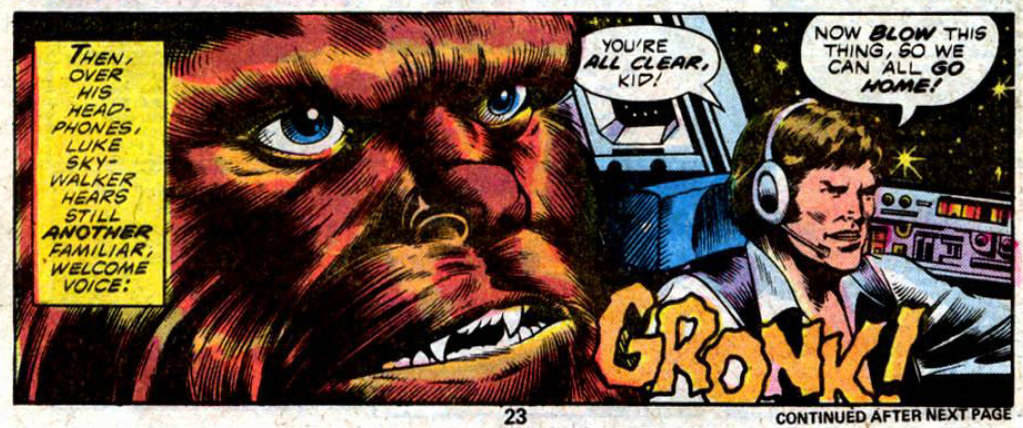
It starts, logically enough, right after the movie. The Rebel Alliance knows it needs a new base of operations since after the destruction of the Death Star, the Empire will come looking for revenge. Han and Chewie have more pressing issues: their debt to Jabba. Opting out of the Rebellion, they make haste to Tatooine with a cargo hold full of money.

Pants Optional

Along the way, they're waylaid by space pirates under the command of the physically imposing Crimson Jack. Shaken down for the money, Han & Chewie are forced to detour to a crappy backwater desert that's an even bigger podunk than Tatooine: Aduba-3.

There, the two get involved in a fracas where an insectoid alien priest is trying to bury a cyborg who looks an awful lot like a Legion of Super Heroes villain in the spacers' cemetery, and the spacers won't have it. Its a simple enough job after a shootout, and the “star-hoppers” (as spacers are called a bunch in this issue) celebrate their winnings in the local cantina, where a group of villagers show up looking for help.


This is part filler issue and part setup. It sets up Luke & Leia searching for a new Rebel Base (that would eventually be Hoth, but its doubtful Marvel, or even Lucas, knew that at this point) and we shift to Han & Chewie smuggler shenanigans. Crimson Jack and his first mate Jolli make a strong initial impression and leave, which leaves them open-ended for a return appearance.

The arrival on Aduba-3 shifts into a Western mode, with a frontier boom town that went bust. The anti-robot prejudice is an interesting angle that will be revisted again and again in early Marvel Star Wars because the Empire's anti-alien prejudice wasn't established yet.


By itself, its a decent issue and a necessary downshift in focus from a giant space battle for the fate of the Rebellion. It can't quite shake off that filler issue vibe, though.

Sunday, April 29, 2018

Marvel Star Wars: Issue 6: Is This the Final Chapter?


The cover is inaccurate. There are no Y-Wings in this issue.

Issue six closes out the adaptation of A New Hope with wall-to-wall space battle action. Its the entire Battle of Yavin, and Luke Skywalker & Blue Squadron fight their way to a hard-earned victory. Han saves Luke, Death Star blows up, everybody except Chewie gets a medal, you know the drill.

The scope of the battle here is much smaller than the movie. Gold Squadron's Y-Wings are completely absent. Blue Squadron consists of six starfighters, and that's it.


The final issue shakes up the creative team. While Roy Thomas and Howard Chaykin remain as writer & penciller, the inks are now done by Rick Hoberg (who apprenticed under the great Russ Manning) & Bill Wray (who would go on to work on Ren & Stimpy and other animated shows) and the colors are by the future wife of Dave Cockrum, Paty (they married in 1978).

The different inks and colors give it a completely different feel to the action. The inks are thick and the neon colors are strikingly bold. Its some of the most consistently dynamic art of the adaptation, and just about every page looks like it would make for a great pop art poster.

No lie, I would hang this on a wall

And that wraps up the 70s Marvel adaptation of Star Wars (A New Hope was added later). Its okay. Its not great, and even for its time, the art isn't consistently great compared to other Marvel books from the time (Avengers was still an A level book and X-Men was on its way up. Savage Sword of Conan was knocking it out of the park consistently with top level art). As a read, its okay, but aside from the script differences, there's no real reason to choose to read these six issues over re-watching A New Hope.

Its an interesting time capsule of popular Sci-Fi commercial art from the late 1970s and an early look at interpreting the Star Wars universe, but there's not much to it beyond that. Optionial tier.


However, the issues sold very, very well, and Marvel found themselves with a successful book with a demand for an ongoing series, so ongoing series it became.

That's where it gets really interesting.


Marvel Star Wars: Issue 5: Lo, The Moons of Yavin!


Having escaped from the Death Star, our heroes fend off a TIE fighter attack. An attack that was all too easily thwarted, because the Empire attached a tracking device to their ship.

We need to bring back exclamation points at the end of every issue title!

Aboard the Falcon, tensions rise between Luke, Leia and Han about money and Luke's attraction to the Princess. The ship reaches Yavin IV with the Death Star plans and an attack strategy is prepped. Luke signs on as an X-Wing pilot while Han & Chewie get paid and get ready to leave.


There's a happy reunion with Biggs and he meets Blue Leader. Yes, Blue Squadron, not the Red Squadron of the final film. Preparations complete, the starfighters leave the moon for their fateful mission.

This is going to get real awkward in 1983

This issue adds some more cut scenes back in, especially in the hangar before Blue Squadron leaves, which is a good decision to wrap around Luke & Biggs' relationship as it was established in the first issue.

This issue added Glynis Wein as the colorist, who was one of the most respected colorists in the industry and the then-wife of Len Wein, a comics legend in his own right (He co-created Swamp Thing and helped save the X-Men from total obscurity in the 70s by co-creating Wolverine, Nightcrawler, Storm & Colossus and putting them on the team). Just some fun side details.

Saturday, April 28, 2018

Marvel Star Wars: Issue 4: In Battle With Darth Vader


Luke, Han & Chewie have rescued Princess Leia, and jump into the garbage chute to escape the detention block. Garbage masher, escape, split up, Luke & Leia kiss and swing across a chasm, and everyone gets back to the Falcon in time to see Ben Kenobi's last duel with Darth Vader before they escape the Death Star's hangar. The creative team of Thomas, Chaykin, and Leialoha remains.

Hindsight is 20/20

Again, there's not a whole lot to say about this issue. It hews closely to the final product of the movie with a few art differences. Like Han shooting at the dianoga's tentacle reaching for them when they escape the garbage chute.


Ben Kenobi is also a lot sassier in his duel with Vader, which is a lot more visually dynamic than the film version. Then it ends on one of the weirdest depictions of Kenobi's death ever.

Its been 40 years. No spoiler warning for you

Its dynamic, its painful, its weird. It looks like Ben's electrocuted and incinerated at the same time, which I guess kind of works as a killing blow for a lightsaber, but even then lightsaber cuts were depicted inconsistently in the Original Trilogy. Sometimes they cauterize and sometimes they leave bloody messes. The only way the panel works at all is thanks to the 70s colors. Its a curious end to a well choreographed fight.


Friday, April 27, 2018

Marvel Star Wars: Issue 3: Death Star!


Issue 3 picks up on the Death Star and Alderaan gets blown up on page two. That's where we are in the movie. In hyperspace, Ben Kenobi senses the destruction of the planet and then gives Luke his first lesson in Force training, which is slightly different from the movie.


They get to the Death Star and begin the rescue of Princess Leia. That's about it.

Not much different from the movie, and this is an action-oriented issue. The creative team of Roy Thomas, Howard Chaykin and Steve Leialoha remain, and the art is steadily improved from the last issue.

Wish I had more to say about this issue, but oh well. Gotta get through the movie adaptation issues before the real interesting stuff starts.


Marvel Star Wars: Issue 2: Six Against the Galaxy!


Picking up with the Tusken Raider attack, there is a definite change in the quality of the art. Roy Thomas is still the writer and editor, Howard Chaykin remains the illustrator, but the addition of Steve Leialoha as the embellisher (inker) and colorist changes the entire texture of the issue. Leialoha would go on to have a long career, working at Marvel and DC on various titles.

Gone are Chaykin's sketchy in strokes, and the whole issue has a more photo accurate art style in general. I would assume that they received reference photos from Lucas as the movie came closer to release, but that's assumption. There are also more blues in the color palette, adding a cooling balance to the reds and oranges.


The plot follows along closely with the movie. Ben saves Luke and starts telling him about “The Force.” (Their quotes, not mine). Darth Vader interrogates Leia. Luke & Ben find the wrecked sandcrawler and then Luke's farm is burnt down. They go to Mos Eisley and hire Han Solo and Chewbacca. There is a firefight in the docking bay and they make the jump to lightspeed in the Millennium Falcon.


One point of difference is the deleted scene where Han meets Jabba that was restored in the Special Editions. This was well before Jabba's design was finalized as a giant slug, so here we have a random alien who would later be retconned as Mosep Binneed, Jabba's accountant and occasional face-man.


There's not much to say about the issue. Its a faithful adaptation of that section of the movie and the slight shift in art style is for the better.


Marvel Star Wars: Issue 1


I've spent more time than I really needed to thinking about how to approach the old Marvel Star Wars ongoing from the 70s and 80s. It was one of the original tie-in materials and would end up being a constant thread throughout the Original Trilogy's theatrical run and even outlived it, ending in 1986 with issue 107. That's almost a decade of comics and taken as a whole, its an impressive body of work. Individually, though, it goes in fits and starts, so that's how I figured I wanted to go through the series: Individually, and in fits and starts.

Launching in 1977 right before Star Wars was released (remember, A New Hope was added later), the first issue features scripting and editing by Silver & Bronze Age comics luminary Roy Thomas with art (pencils and inks) by Howard Chaykin early in his career.

The issue covers the beginning of the movie up to the point where Luke is attacked by Sand People in the Jundland Wastes while looking for Artoo.


Like the novelization, the comic script follows an earlier draft of the script than what the final movie would have. There's a lot more Luke on Tatooine stuff, where he witnesses the space battle from the ground and has a farewell meeting with Biggs. Its not something really missing from the movie, but in a medium like comics, the scene adds some good characterization beats for Luke's desire to get off Tatooine.


The art is very 1970s. Vehicles are oddly proportioned and frequently off-model, Chaykin's inks are frequently thick over somewhat sketchy pencils and the colors by Marie Severin are heavy on the reds, oranges and pinks in places. The hyper-stylized color scheme holds together thanks to Chaykin's dynamic poses, but I wouldn't call the art especially great, even for its time. 

Recently, Marvel re-released the six original issues in a “remastered” form with modern coloring techniques and a film-accurate palette, and it just looks like badly proportioned art (It kind of is, but the original coloring helped it stand as a stylistic choice).

The Biggs stuff is nice, the art can be polarizing, but it does feature the best version of Vader choking Admiral Motti, where he casually uses the Force to bring him a cup of coffee while he tortures him.


Wednesday, April 25, 2018

Legends Never Die: The Truce at Bakura


Released at the end of 1993, The Truce at Bakura followed hot on the heels of the Thrawn Trilogy. The first standalone Star Wars novel since Splinter of the Mind's Eye, Bakura is often overlooked in the early Expanded Universe since a lot of the things it introduced weren't really touched upon later and would get swallowed up in the blitz of EU material that was to come in 1994.

Its author, Kathy Tyers, was relatively new at the time. Her first book, Firebird, was published in 1987, with three more novels published before Truce at Bakura, all through Bantam Spectra (which had the Star Wars rights in the 90s).


The book begins immediately after the Battle of Endor. The victorious Rebel Alliance is licking its wounds and taking stock of the situation. Luke is exhausted and badly injured from his confrontation with the Emperor (and his Dark Side lightning), but he's forced into action when an obsolete message pod arrives in the system from an Imperial-held world that has been invaded by aliens. Sensing an opportunity to win over “Hearts and Minds,” Alliance High Command decides to send a small force to rescue the planet, Bakura, and diplomatically sway them away from the now-headless Empire.

An escort carrier and several fighter squadrons are all that can be spared, but Leia Organa is in charge of the diplomatic mission (Han, Chewie & the droids are along for the ride too, of course) and Luke is put in overall military command.

That's right, eagle-eyes. Rebels re-used the Quasar Fire-class in NuCanon

Arriving in the Bakura system, they find a well-developed world that was originally settled by corporate interests and developed a thriving repulsorlift industry. The locals hate droids thanks to an old uprising in the past, but they've only been recently incorporated into the Empire and many don't have a problem with its rule over them. A tentative truce is established to fend off the aliens, the reptilian Ssi-Ruuvi Imperium from the Unknown Regions.

Then all hell breaks loose when the truce is broken.

There's a lot going on inside this book. Luke is badly in need of rest and healing, but the burdens of his obligations (and because Ben's Force ghost told him to go) push him forward. He struggles with command, resisting the temptation of using the Dark Side to make life easier, detecting a Force user among the alien force, and an attraction to a pretty young Imperial senator from Bakura.


Leia's conflicts are more direct. She's got to deal with the Bakuran government that is only partly Anti-Imperial. The local governor proves to be a capable and wily negotiator himself. She does get some great personal moments, like where she wrestles with the knowledge of being Darth Vader's daughter, even going so far as telling Anakin's Force ghost off when he appears asking for forgiveness. She's written a bit inconsistently, too. Part of the agreement of the truce is that the Rebels won't stir up seditious behavior, which is exactly what she does. There's little things like that that stand out.

The new characters end up being some of the most interesting.

Commander Pter Thanas, the man in charge of military defense with his small Carrack-class cruiser, is actually a Good Guy Imperial. So good that he refused to punish an alien planet under his control and was transferred to a sleepy backwater for the rest of his career. He struggles between his duty and his conscience throughout the book.

Governor Wilek Nereus isn't a cartoonishly evil dictator when he's introduced. He rules Bakura with a fairly open hand, while never letting them forget who really rules their Senate. As the fighting worsens, his darker side comes to the surface, and he's revealed as an inveterate schemer with a fondness for poisons and taking the teeth of game he has hunted.

Gaeriel Captison is the pretty young Senator and an Imperial loyalist who fears the reputation of the Jedi and their abilities. She's also deeply religious, and devoted to the Cosmic Balance, which holds that a good deed on one end of the galaxy will be balanced out by a bad deed on the other end. Part of her fear of the Jedi stems from the belief that they heavily upset that delicate balance. Tyers herself is openly Christian (and later in her career would focus on writing Christian Sci-Fi), and the facet of Gaeriel's character isn't treated as a joke or something that overpowers the character, which is nice.


She's also got heterochromia of the eyes and her presence in the Force drives Luke's hormones wild, but she's actually not a mary sue, since she's not good at everything. She's only good at diplomacy. Unfortunately the romance between her and Luke doesn't really work, so its probably for the best that it doesn't work out between them by the end of the book.

The Ssi-Ruuk are an interesting race. Derisively called “fluties” because of their high-pitched language, they're xenophobic, imperialist dinosaur-men who believe that only they have souls. They capture and enslave people to power their technology, forcibly sucking out the life energy and consciousness of living beings (humans are great for this) to power their electronics and droids. This is called “entechment” and it lasts until the machine is destroyed or the poor bastard inside goes completely insane and dies a second death.

Its really quite horrifying.


Among them is a fifteen-year-old human boy named Dev Sibwarra. He's a powerful Force sensitive with strong empathic abilities and he's deeply affected by Stockholm Syndrome in a galaxy that doesn't even have a Stockholm. Poor Dev is a true believer in the Ssi-Ruuk cause and longs to be enteched, despite being abused for even minor failings. He's the presence that Luke sensed, and is part of why Luke drives himself to the physical brink trying to save this kid.

Also, Dev is brown-skinned of the Indian subcontinent variety, but that's secondary because this is how you do diversity without forcing it and publicly patting yourself on the back for inclusivity.


The overall plot is interesting and hustles along briskly, and the space combat scenes are well done. The middle bogs down a bit where it turns into diplomatic posturing. Han doesn't have a whole lot to do, aside from shoving Threepio into Stormtrooper armor at one point and doing space stuff in the Falcon. Some of the side characters, like the crew of the carrier Flurry, are untapped potential.

Its a Luke and Leia focused story that explores bittersweet themes of failure and loss, and sits on the better end of the Expanded Universe spectrum. The Ssi-Ruuk are an interesting, if one-dimensional villain race, and I like them because they're weird.

Not on the top level with Heir to the Empire or Han Solo at Stars' End, but still in the recommended tier. 

Legends Never Die: Han Solo and the Lost Legacy


Han Solo and the Lost Legacy caps off Brian Daley's Han Solo trilogy, and was published four months after The Empire Strikes Back was released.

Frozen in carbonite, book trilogy ended. 1980 was a rough year to be Han Solo.

After making haste out of the Corporate Sector, Han, Chewie, Bollux and Blue Max are bumming around a backwater sector called the Tion Hegemony doing odd jobs like working for a flying circus.

Adventure comes calling in the form of one of Han's old academy instructors turned treasure hunter: Trooper Badure. Badure's recruits Han to get to the planet Dellalt to find a long-lost treasure ship, The Queen of Ranroon. The ship belonged to a fabled pre-Old Republic conqueror, Xim the Despot, and is said to be guarded by a legion of his deadly war robots. The ship has been the stuff of spacer legends for generations.

After a high-speed chase across a university, Han agrees and meets the rest of Badure's team: Hasti, a miner who's sister discovered the clue to the treasure's location and was killed for it, and Skynx, an eager Ruurian historian who's just about the most adorable fuzzy caterpillar person in the galaxy.


Dellalt proves to be a dangerous world, with a criminal mining operation, a reclusive group of deadly cultists in the mountains, and centuries-old war robots that are just as deadly as their reputation.

And then Gallandro shows up with a grudge against Solo for being humiliated in Han Solo's Revenge.

Considering Raiders of the Lost Ark came out a year later in 1981, the comparisons are inescapable. A character played by Harrison Ford goes on a hunt for ancient treasure and has to deal with angry natives and hostile armies. Probably coincidental, but the pulp element convergence here is striking.

Gallandro himself works as a stand-in for the sinister Setenza from The Good, The Bad and the Ugly. His moustache is a little more flamboyant, but there's a lot of Lee Van Cleef in the character. He is one of the few people in the galaxy that Han is legitimately frightened of.


Like the rest of the trilogy, Daley's action sequences are fast-paced and exciting. The aforementioned university chase (which itself has a lot of similarities to one of the few bright spots in Kingdom of the Crystal Skull), then there's a mountain chase on a giant metal disc, and a large-scale battle at the climax where everyone's fighting everyone as the war robots advance.

This time, though, there's a tinge of melancholy throughout. Its been a fun ride, but the party's coming to a close. Han makes more mistakes. Hasti, the potential love interest, rejects his advances, saying she wants something real and not a love-em-and-leave-em type. The ancient labor droid Bollux has a touching conversation about obsolescence and free will with the war robot commander. Skynx the academic is rushing to get as much adventure and knowledge into his life before he matures to a full adult and turns into a near-mindless butterfly. Bollux and Blue max have to leave Han by the end because they're not in the movies.


The passage of time undercuts everything in this book, and by the end, Han & Chewie have managed to piss off everyone important in the Corporate Sector and Tion Hegemony, so they bounce around the idea of doing a simple spice run for Jabba the Hutt.

The Han Solo Adventures are a blast to read and can be found individually or in omnibus formats. If you're of a tabletop persuasion, its essential reading for a Scum & Villainy type of game. Highly recommended and essential Expanded Universe reading.


Brian Daley would continue on with a few Star Wars projects, but not more novels. He wrote the script adaptations for the Star Wars Radio dramas (1981, 1983 and 1996, respectively). The audio dramas are really quite good, by the way, and expanded on a few themes that weren't in the movies.


Daley himself died in 1996 of pancreatic cancer shortly after recording of the Return of the Jedi radio drama wrapped. According to his official website, which is still up as a memorial to him, some of his ashes were to be scattered at the Little Big Horn Spirit Gate memorial to help defend it from inter-dimensional threats. 

Legends Never Die: Han Solo at Stars' End


Han Solo at Stars' End is the second ever Star Wars novel. Published in 1979 by Del Rey, one year after Splinter of the Mind's Eye and two years after the original movie, this was a book of firsts. The first Han Solo-centric novel (the smuggler doesn't even appear in Splinter for reasons I covered in that review), it takes place before A New Hope and follows Han and Chewie's criminal escapades in a new location, the Corporate Sector.

Brian Daley (1947-1996), was a new author in 1979, having published his first novel, The Doomfarers of Coramonde (a story about US soldiers in Vietnam being transported to a fantasy world, which frankly, sounds like a blast) and its sequel, The Starfollowers of Coramonde in 1979. Daley was young, new, and pulpy, and it shows in Stars' End.

The book starts with Han & Chewie running guns for a group of oppressed laborers. Then they almost get impounded for not having the right kind of registration for the Millennium Falcon to operate in the Corporate Sector, and then they get swept up in a search for a missing outlaw tech named Doc who can help with the registration problem that turns into a murder mystery covering up a totalitarian prison on the edge of the galaxy known as Stars' End.


It may not be pulp in the traditional sense, but its a short book and whips from scene to scene with barely any fat. Han Solo as he is here is a committed rogue, scoundrel, and selfish jerk. When he pays back a loan shark named Ploovo Two-For-One, he adds in a vicious little exotic pet that jumps out of the box and attacks Ploovo. He doesn't accept the missing persons' job for free, doing it because he needs to get the Falcon's registration fixed.

Yet there's flashes of the hero he will become. He gives free advice to the aliens he smuggles guns to in the beginning. It takes some prodding from some of the characters, but he sticks it out with the search for Doc.

The new characters are well handled. Jessa, Doc's outlaw tech daughter is a talented tech and fighter pilot in her own right who can match verbal barbs with Han. Atuarre, the Trianii (cat people) ranger looking for her missing husband is a solid warrior woman kind of character who has very personal stakes in the mission. Rekkon, the academic who's much more capable of adventuring than a mere professor would seem is the only true idealist here, and he's a fantastic mentor for Han as somebody who knows to prod him in the right direction. Also, Rekkon's arguably the first important black character in Star Wars, predating Lando by several years, and he's intelligent, cunning, and heroic.


The real standouts are the droids Bollux and Blue Max. Blue Max is an eager little super computer who's amazing at technical feats but has the personality of a child and can't move around by himself. Enter Bollux: a positively ancient labor droid with a laconic personality and Southern drawl who's chest cavity is transformed into a housing unit for smuggling Max. They're fantastic.

The set pieces work out great too, including a fantastic dogfight that introduced early swing-wing versions of Z-95 Headhunters to Star Wars. The escape from the agriworld of Orron III by stealing and reprogramming a harvester droid is great. The climactic prison break at Stars' End ends up with Han blasting the entire station into low orbit and then having to find a way to escape before it comes crashing back down. Its awesome. What's more impressive is that it manages to capture a strong Star Wars feel without the Force and the Empire (well, there's a reference to the Imperial Entertainers' Guild, but that's it). If there's any real complaint I can think up is that aside from the Corporate Sector Authority's heavy-handed bureaucracy, there's no real meaty villain until they reach Stars' End.

In 1980, comics veteran Archie Goodwin (who helmed much of Marvel's Star Wars ongoing comic) and Filipino artist Alfredo Alcala adapted the story to a newspaper strip, which was later collected and printed by Dark Horse in 1997. The technology doesn't always match up with descriptions (Z-95s are described as having swing-wings and the comic doesn't portray them as such, so continuity wonks will grit their teeth) and the strip excised a LOT of the story, but its still a fun read.


Han Solo at Stars' End is damn good space opera. As a Star Wars story, its wickedly fun, fast, and action-packed and perfect for anybody looking for Scum and Villainy adventures. Its on a smaller scale than the Thrawn trilogy, but just as good. Essential tier

Plus, Han launches a villain out of a space lock.

In hyperspace.

I'd like to see Greedo try and do that first.